
Publishing companies are writing down how they use AI. When you self-publish, you are the company. A one-page note on your desk is enough to start.
The Book Industry Study Group (BISG) and BookNet Canada surveyed book-industry professionals across the U.S. and Canada for their 2026 report on AI use. They drew on 771 responses. On the BISG summary, posted 28 September 2026, 49% of respondents said their organization now has an official AI policy or guidelines, up from 31% in 2025. These are industry professionals, not a poll of indie authors. The point still lands for a one-person list: someone else already decided, in writing, which tasks AI may touch and who checks the work.
What the report also shows
The same BISG summary says the most common organizational approach is to encourage AI within controlled workflows or for specific tasks. The work itself stays practical. For both individuals and organizations, the top uses are administrative and operational tasks and marketing, followed by research, data analysis and reporting, and metadata and title optimization. BookNet Canada’s post on 29 September 2026 breaks the same pattern out with percentages for admin and marketing.
Among people already using AI, 72% said it increased their efficiency or productivity (BISG, 28 September 2026). The report also records the other side: time spent correcting wrong results, refining prompts, and reviewing outputs. A short policy is not only a trust signal. It is also how you decide what AI is allowed to draft so you do not lose an afternoon fixing something you never needed.
The Alliance of Independent Authors (ALLi) encourages members to publish a short AI policy on their own website as a trust signal for readers. It does not require one. You can still write yours.
Your one-page template
Copy these three lists onto one page. Fill them in for your own books. Keep the page next to your publishing checklist.
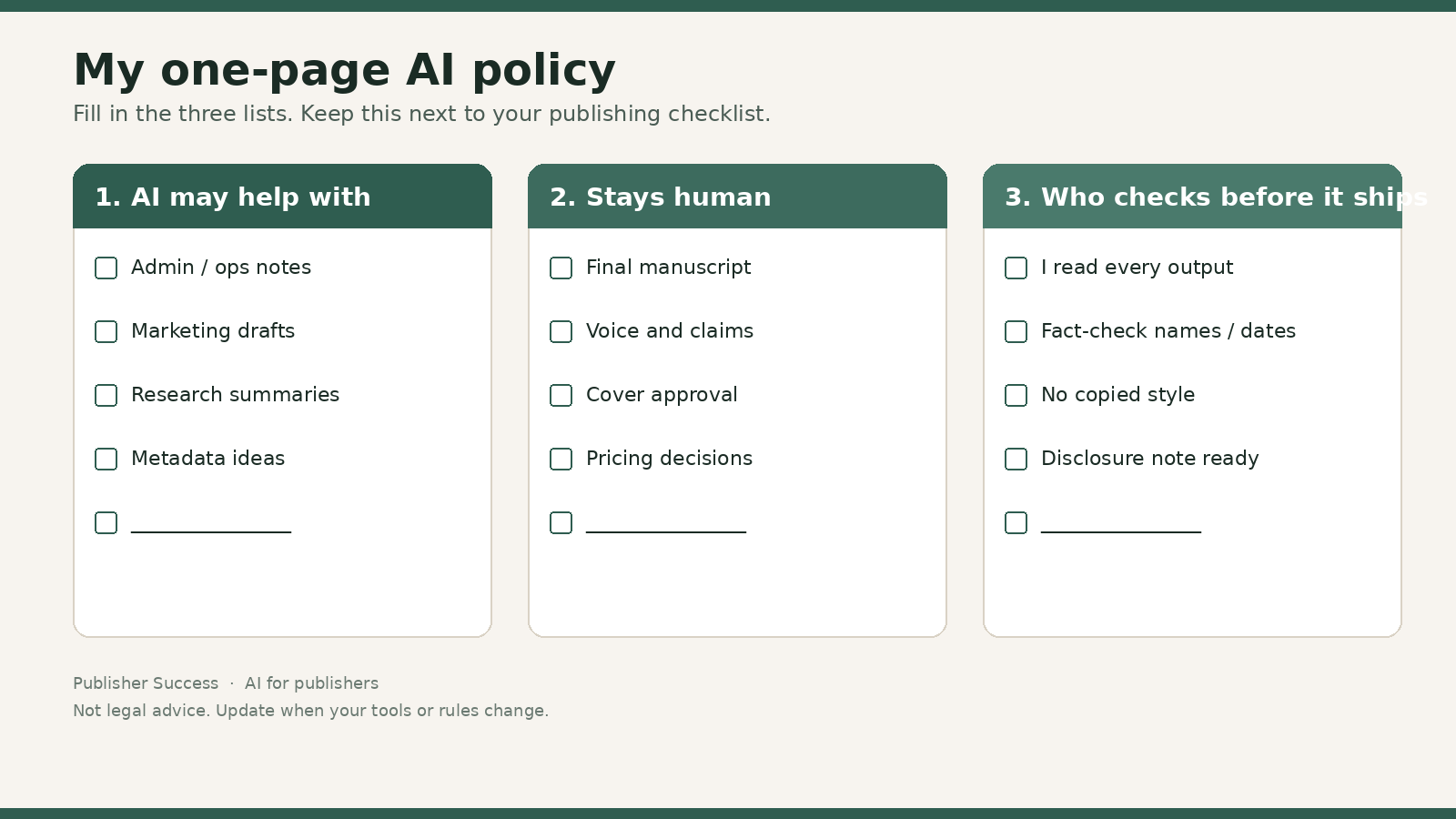
1. What AI may help with
Examples that match how the industry is already using these tools (BISG / BookNet Canada, September 2026):
- Admin and operations notes
- Marketing drafts and ad variations
- Research summaries you will verify
- Metadata and title ideas you will edit by hand
Add only the tasks you are willing to review before they go live.
2. What stays human
- The final manuscript voice and claims
- Final cover approval
- Pricing and rights decisions
- Anything you would not put your name on after a quick skim
3. Who checks every AI output before it ships
- Name the person. If you work alone, write your own name.
- Read the full output before it ships.
- Check names, dates, quotes, and links.
- Keep a one-line note of what AI touched on each book.
Disclosure stays separate
When Amazon KDP asks what to tell it about AI on a book, follow our earlier note: Used AI on your book? What to tell Amazon KDP. Your policy decides what AI may draft. That note covers what you report at upload. This page is not legal advice.
Write the three lists once. Update them when your tools or your rules change. That is the whole lesson.