
You open your Bookshelf to set up next week’s release and hit a wall: only two new titles per format this week. The same week, trade headlines describe “click-to-publish” AI books. What matters is whether a person is still responsible for the book.
Two September 2026 signals point the same way. South Korea’s publishing groups published voluntary AI-use principles built around disclosure and human responsibility. Amazon KDP tightened how many new titles you can create each week. Together, they reward intentional catalogues over volume dumps.

What Korea’s publishers just put on the table
On 29 September 2026, the Korea Publisher Society (also rendered Korean Publishers Society / Association in English coverage) hosted a publishing and AI policy forum at Mapo Central Library in Seoul. There it unveiled the Principles for the Use of AI by Publishers and Authors for Readers—five chapters and 20 articles, reported by The Korea Times on 30 September 2026.
The documents are voluntary, not law. The Korea Times reports they were drafted with peer groups including the Writers Association of Korea and the Critics Alliance (outlet counts differ: eleven organizations in The Korea Times; twelve in Seoul Economic Daily). The aim, per the Society, is to keep books trusted when AI-generated “click-to-publish” titles are easy to ship.
Core ideas, as reported:
- Humans create books and remain responsible for them. AI is a tool, not an author or co-author.
- Disclose AI use so readers can see it.
- Training-data use of publications should involve rights-holder consent and fair compensation.
- Supporting themes in the principles include identification of AI use in production and distribution, training-data guidance, and contract recommendations.
Yoon Sung-hoon, chairman of the Publisher Society’s AI Future Strategy Committee, told the forum (as quoted by The Korea Times): AI is merely a tool and does not have the status of an author; if AI is used in the publishing process, that fact should be transparently disclosed to readers.
Society chairman Hong Young-wan stressed the standards are not meant to reject AI or put a “scarlet letter” on AI-generated content—they are meant to push for practical industry benefit while legal frameworks catch up.
English coverage from Seoul Economic Daily and The Kyunghyang Shinmun adds a recommended three-level labeling approach based on human verification: human-authored works (limited AI for tasks like proofreading or outlining), AI-assisted works (human control and verification of AI-supplemented or AI-generated material), and AI-generated publications (AI material without that human control). Levels two and three are recommended for imprint-style labeling. Treat those tier names as reported recommendations from Korean trade coverage, not as a global Amazon rule.
The indie takeaway: craft, disclosure, a named human
You do not need to be a Korean trade publisher to use the same posture.
1. Decide what AI did—and write it down for yourself. Proofread only? Outline help? Drafted chapters you rewrote line by line? If you cannot say which, you are not ready to publish.
2. Put a human on the hook. Someone must own accuracy, originality, rights clearance, and reader promises—especially in medicine, law, investment, children’s, and education topics, where Korean coverage notes stronger review is urged.
3. Disclose at a level your readers can find. Copyright page, “About this edition,” or product description—wherever you already put edition notes. Match the spirit of the principles: readable disclosure of whether AI was used and how far.
4. Prefer fewer, finished books over a weekly spray. That is the opposite of click-to-publish. It is also what platform capacity now forces.
The KDP weekly cap: plan launches, don’t panic
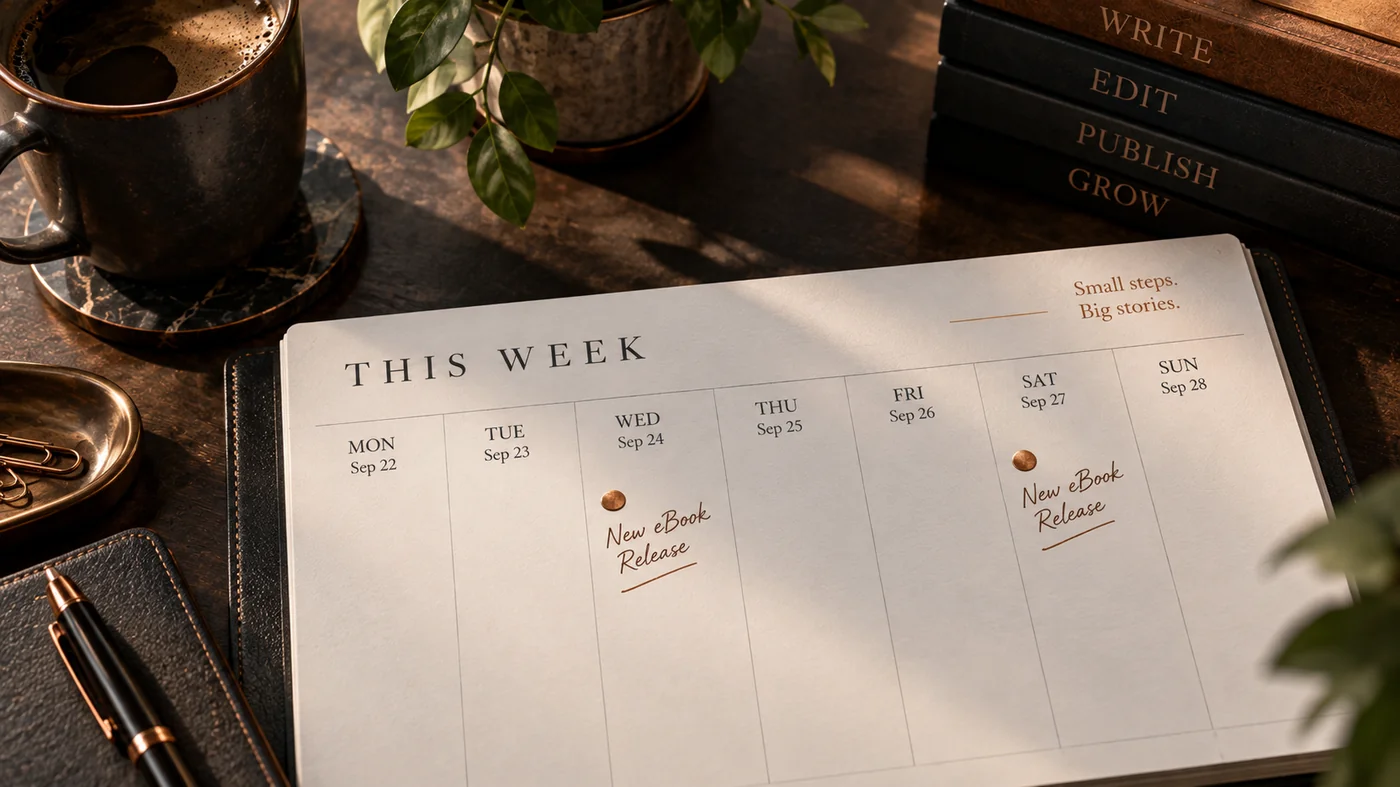
Separately, Amazon reduced KDP’s new-title creation limit. The Bookseller (24 September 2026) reports the limit fell from 10 to 2 uploads per format per week, in force from 21 September 2026, covering new Kindle eBooks, paperbacks, and hardcovers. Already published titles are unaffected.
KDP’s own Help page (“Create a Book”) now states authors can create 2 titles per book format each week, “to ensure a positive experience for all authors.”
The Alliance of Independent Authors’ Self-Publishing Advice Centre quotes Amazon’s short notice: the weekly limit resets every Sunday at 12:00 AM UTC, and the change applies to new titles only. ALLi also notes earlier title-creation limits (a first limit as far back as 2023; a ten-title limit more recently).
What Amazon did not do: confirm AI as the reason. The Bookseller reports Amazon declined to comment on whether the policy change is due to AI-generated content. A spokesperson spoke instead about safeguarding a bookstore readers love and that authors and publishers can trust. Forum speculation and trade commentary exist; treat them as commentary, not Amazon’s stated cause.
Practical launch planning under the cap
- Count by format, by UTC week. Two new eBooks, two paperbacks, and two hardcovers can still be created in the same week—the counters are separate, per trade reporting and KDP’s “per book format” wording.
- Create early if you need a same-day multi-title release. Pre-orders and staged Bookshelf setup let you spread creation across weeks while aligning go-live dates. (Confirm current pre-order rules in KDP Help before you lock a plan.)
- Stagger box sets, translations, and backlist migrations. Each new title uses a slot. A series, a box set, and a novella in one format in one week is three creations—one waits.
- Edits to live books are not the same as new creations. Trade coverage and Amazon’s FAQ language emphasize new titles; price, description, and manuscript updates on published books are the path for catalogue care without burning slots.
- Quality over velocity. When the platform chokes volume, the authors who win are the ones with finished fronts, clear positioning, and a release calendar—not the ones trying to upload ten drafts before Sunday UTC.
What serious use looks like
Korea’s principles and KDP’s cap are different instruments. One is a voluntary industry promise about trust. The other is a hard throttle on how fast new SKUs appear. Both punish the same habit: treating the store like an open pipe for undifferentiated files.
Serious use looks like:
- A human editorial pass you would defend to a reader.
- Honest labeling when AI shaped the work.
- A release plan that fits two new titles per format per week—and still serves the series.
The habit these two signals push against is shipping files with no named person responsible, no disclosure, and a plan to fill every weekly slot.
The Publishing Success Accelerator, a community on Skool, is built for authors who want release planning and catalogue discipline, not a weekly upload race. The Accelerator's free 7-day trial opens 1 October 2026. Read about the Accelerator trial.
Results vary. AI and KDP policies change—check current KDP Help and your local disclosure or rights rules before you publish.